A desktop browser with x402 built in: when a page asks for payment, it pays in stablecoins and shows the content.
- .githooks
- .github
- apps
- docs
- packages
- .env.example 2.1 KB
- .gitignore 295 bytes
- CHANGELOG.md 27.0 KB
- LICENSE 11.1 KB
- NOTICE 168 bytes
- README.md 8.8 KB
- SECURITY.md 2.9 KB
- package-lock.json 97.6 KB
- package.json 688 bytes
dbbasic-browser
A browser with first-class x402 support — pay for web resources in stablecoins, transparently, at machine speed. Point it at a page that returns 402 Payment Required and it reads the price, pays, and shows you the content. No popup, no API key, no subscription.
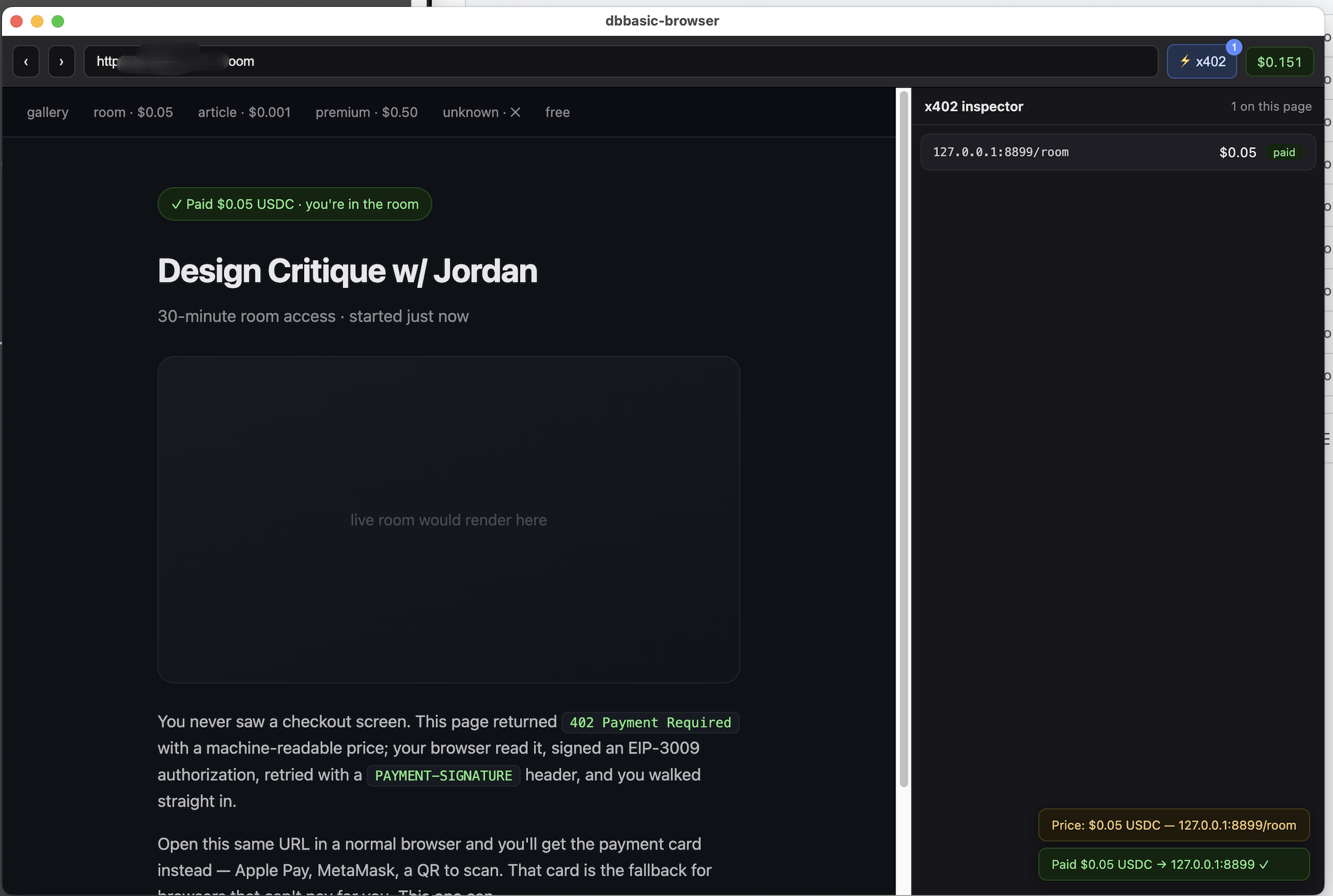
Same URL that shows a checkout card in a normal browser opens straight into the paid content here. The ⚡x402 inspector (right) shows the payment that just happened — challenge, decision, signed authorization, receipt — while the toolbar tracks your wallet balance and spend. (Local demo gallery.)
Status: early, but it moves real money. The engine, proxy, and Electron shell work and are tested. The browser signs real EIP-3009 authorizations and settles them on-chain through a live facilitator on Base Sepolia — see the /live route and a confirmed transaction. It is testnet-only and unaudited — do not point it at mainnet with real funds. See Status.
Why this is a browser, not an extension
x402 needs one specific thing from a browser: when a request returns 402, something must inspect the challenge, perform an async signature, re-issue the request with a payment header, and hand the second response back to the page as if it were the first.
A Manifest V3 extension cannot do this. MV3 removed blocking webRequest, and its replacement is declarative — it can't pause a subresource, await a signature, and resume. Transparent payment for arbitrary subresources requires owning the network stack. A browser (via Electron's protocol.handle) or a local proxy can; an extension can't. That's the whole reason this project exists as a browser.
The design principle: don't trust the server you're paying
The interesting engineering here isn't the payment handshake (that's ~200 lines). It's that the resource server is not trusted to describe its own payment. A naive x402 client takes three things straight from the 402 response and signs against them:
- The EIP-712 domain (
name/version) it signs over — so the party being paid
chooses what your wallet attests to.
- The asset, an arbitrary token address — so without pinned decimals a client
can't actually tell whether amount: 100000000 is ten cents or a hundred dollars.
- The authorization lifetime (
maxTimeoutSeconds) — so a server can request a
year-long window, bank your signed authorization, and settle it whenever it likes.
dbbasic-browser refuses all three:
- A pinned asset registry (
assets.ts) is the
root of trust. The EIP-712 domain and decimals come from our table, never the server's extra. An asset we can't price is an asset we won't pay.
- The authorization lifetime is clamped (default 120s), regardless of what the
server asks.
- Because EIP-3009 is signature-based, exposure equals exactly what you sign — so the
signing policy is the security boundary. Budgets are scoped to (the page you're looking at × the origin being paid) and rate-limited, not just amount-limited. A hostile page firing 1,000 sub-cent 402s hits the rate cap, not your balance. Every one of these is covered by a test.
Monorepo layout
packages/engine/   @dbbasic/x402-engine   the payment engine — no UI, no Electron
packages/proxy/    @dbbasic/x402-proxy     a local proxy: any browser/agent, port 8402
apps/browser/      @dbbasic/browser        the Electron browser
The engine depends on nothing but fetch. The proxy and the browser are thin adapters over it, so the payment path a human's browser takes is byte-for-byte the one an agent or a curl-through-the-proxy takes — and all of it is testable headlessly.
Quickstart
Requires Node 22.12+ (Electron 45's requirement).
npm install          # installs all workspaces
# (If your npm blocks install scripts and Electron's binary is missing, run: node node_modules/electron/install.js)
npm test           # unit tests: engine, proxy, vault and browser
npm run e2e -w @dbbasic/browser   # end-to-end: drives the real browser through its automation API
                                   # (macOS/desktop; E2E_LIVE_NET=1 / E2E_LIVE_AI=1 add checks against real sites / real AI keys)
See it pay, in a real browser window:
# terminal 1 — a local x402 example gallery
node apps/browser/demo/x402-demo-server.mjs

# terminal 2 — build and launch the browser (opens on askrobots.com; use
#   Help ▸ x402 Demo Gallery, or HOMEPAGE=http://127.0.0.1:8899/, to start on the gallery)
npm run build   -w @dbbasic/browser
npm start       -w @dbbasic/browser
The demo gallery is a set of x402-gated pages (Help ▸ x402 Demo Gallery), each designed to trigger a different payer decision. Click through them and watch the toolbar and the ⚡x402 inspector:
| Page | Price | dbbasic-browser does |
|---|---|---|
| Live payment | $0.001 | settles for real on Base Sepolia — merchant balance rises, refundable |
| Room / article | $0.05 / $0.001 | auto-pays (mock settlement) |
| Tip jar | you pick | variable — small auto-pays, larger ones prompt |
| Metered API | $0.002 | a JSON endpoint — an agent pays it identically to the browser |
| Two ways to pay | $0.10 / $0.04 | prices both, pays the cheaper one |
| Premium report | $0.50 | asks first (over the auto-approve threshold) |
| Unknown token | — | refuses (asset not in the pinned registry) |
| Free page | — | loads normally, pays nothing |
Everything but /live uses mock settlement, so clicking around is free. Now open the same gallery in a normal browser — it can't pay, so every page renders its human fallback body (a checkout card with Apple Pay, a wallet, a QR). One browser shows payment cards; the other shows the content. That contrast is the entire pitch — and because each page exercises a distinct code path, the gallery doubles as a functional test rig for the payer.
Real on-chain settlement (Base Sepolia)
The browser is wallet-aware: the toolbar shows your USDC balance read live over RPC, a Fund button opens the faucet with your address copied, and the /live route settles a real $0.001 payment through the x402.org facilitator. Watch your balance drop and the merchant's rise, then hit Refund to send it back — so testnet funds circulate instead of draining (the facilitator pays the gas).
To try it: generate a fresh testnet key, fund the address with USDC from faucet.circle.com (Base Sepolia), and set X402_PRIVATE_KEY and X402_MERCHANT_KEY in .env (see .env.example). A gated live test proves settlement independently:
RUN_LIVE_SETTLE=1 npx vitest run live-settlement # from packages/engine — moves $0.001Or use the proxy with any browser or agent:
npm start -w @dbbasic/x402-proxy      # listens on 127.0.0.1:8402
curl -x http://127.0.0.1:8402 http://127.0.0.1:8899/
Contributing
Enable the pre-push checks once per clone: git config core.hooksPath .githooks. They refuse a push whose new lines contain a key-shaped secret, then run the type check and the unit tests. (git push --no-verify skips them.) A clone can add its own extra check as .git/hooks/pre-push.local; the hook runs it if it exists.
Status
Works and is tested: the engine, the proxy (HTTP + HTTPS via a local MITM CA), and the Electron shell (protocol.handle interception, native approval dialog that shows the price before signing, live spend meter, per-tab payment inspector). The browser signs real EIP-3009 authorizations and settles them on-chain on Base Sepolia via a live facilitator, with a working buyer→merchant→refund loop.
Not done yet:
- The wallet is a local key. It reads
X402_PRIVATE_KEYfrom.env(gitignored,
chmod 600). Moving it into the OS keychain, isolated from any real funds, is the next hardening step.
- Testnet only, and unaudited. Real settlement is proven on Base Sepolia; nothing
here has been security-reviewed, and it must not touch mainnet funds yet.
- EVM only. Solana (
exactSVM) is not implemented. - USDC price is hardcoded at $1. Fine for USDC, wrong for EURC or anything
non-pegged — needs a real FX source.
- The seller side is minimal. The demo server settles via the facilitator for the
/live route; a general resource-server/"seller" library lives elsewhere.
Security
This software terminates TLS (in the proxy) and signs payment authorizations. Read SECURITY.md before running it against anything real.
License
See LICENSE.